The biggest limitation in hospitality AI isn't intelligence—it's timing. Real-time data gives AI the ability to influence guest experiences in the moment instead of analyzing them after the opportunity has passed.


There’s no shortage of AI conversation in restaurants, hospitality, and entertainment.
But there’s a quieter reality underneath it:
Most AI isn’t weak. It’s just slow—and in this game, slow is useless.
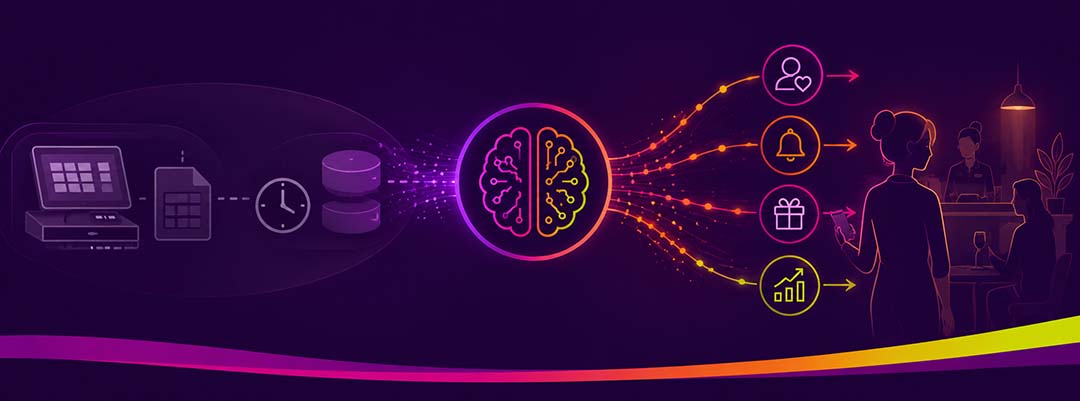
A large portion of the industry is still operating on:
So even when AI is layered in, it’s often working on data that’s already stale, 12–36 hours old.
Which raises a simple question:
If today’s AI is using yesterday’s data, what is it actually changing right now?
The answer? Almost nothing.
There’s an important distinction that gets blurred in AI conversations:
Most systems, such as POS and PMS, are very good at first.
Few can do the second; once data is ready, the chance to act is gone.
AI delivers the most value when it operates inside the decision window:
Without that:
With it:
The difference isn't the algorithm—it's timing.It’s when the system knows what’s happening.
When transaction data flows as events happen—not in batches—something fundamental shifts:
At that point, AI stops being a reporting layer… and becomes part of the operation itself.
Even with faster data, structure matters. Most platforms still silo customer records.
But in the real world, people’s behavior is interconnected:
When those relationships are invisible, so is a large portion of the signal.
When they’re visible:
When you combine:
AI becomes far more practical:
Not because the models changed—
But because the data finally matches the moment. AI is only as good as the data—and timing is everything.
At Mobilozophy, we've focused on solving the timing and relevance problem for hospitality AI—helping businesses take timely action that directly influences guest experience.
mzCONNECT was built around a simple idea:
If you want AI to influence behavior, it must run on data that’s still relevant.
That means:
The AI layer matters only because the foundation works.
There’s a shift happening:
AI value is moving toward systems that can see and act in real time.
For POS and technology providers, that creates a fork:
Neither is right nor wrong.
But the second requires a different approach to data and integration.
AI in hospitality isn’t limited by intelligence. It’s limited by timing. Data is power—only when it’s fresh.
Without real-time data:
You understand the past.
With it:
You can still shape the outcome.
If you’re building, positioning, or partnering around AI…
It may be worth asking: “How close to real time is our data, really?”
That answer usually reveals the most actionable opportunity for progress.
Real-time engagement doesn't require replacing your POS or PMS—it requires extending what those systems can do. If you're evaluating how AI and real-time customer engagement fit into your technology roadmap, we'd welcome the opportunity to continue the conversation by exploring what's possible together.