Data records customer behavior. Signals reveal customer intent. Learn why the future of marketing belongs to organizations that can recognize and act on the moments that matter most.


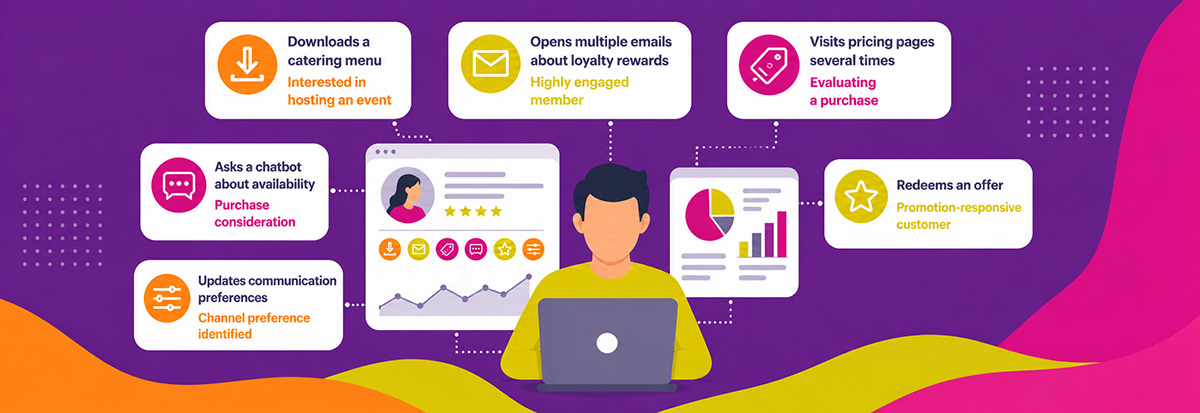
Marketing teams today collect more customer data than ever before - website visits, email clicks, purchases, loyalty activity, chatbot conversations, and more.
The challenge isn't collecting data. The challenge is understanding what that data actually means. This is where signals come in.
A signal is when a customer does something that reveals their intent, interest, preferences, or what they might do next. Think of signals as answers to the question: "What is this customer trying to tell us?"
While raw data simply records what happened, signals help marketers understand why it matters. For example, when a customer downloads a catering menu that might signify the person is interested in hosting an event.
The action itself is data. The interpretation becomes a signal.
While many marketing automation platforms include a CRM or CDP to store data, it's really up to marketers to understand what the data is telling about a customer and what action to take next.
Signals help close the gap.
Instead of asking: What data do we have?" Marketers can ask: "What is the customer telling us?"
This shift helps organizations:
One of the biggest misconceptions is that signals only come from explicit customer actions, such as completing a form.
In reality, signals can be derived from multiple sources.
Let's say a customer completes a website form; they are offering insight into their interests or preferences.
For example:
These responses can serve as immediate, actionable, signals (ChatGPT, 2026).
A customer profile is more than a collection of stored data. It often provides clues about an individual's habits, preferences, and interests.
For example:
On their own, these details may not seem particularly significant. However, when viewed together and combined with other customer interactions, they can help paint a more complete picture of the customer and provide useful context for future communications and engagement (ChatGPT, 2026).
Some of the most valuable signals come from unstructured conversations.
A customer might type:
"What is the weather in April?" or "What is your cancellation policy?"
These questions may indicate purchase intent, urgency, or interest in a specific product or service.
Today's modern AI-powered systems can evaluate conversations and convert them into structured signals that marketers can use across campaigns, segmentation, and automation.
A simple way to think about it:
Data tells you what happened. Signals tell you why it matters.
For instance:
Not every piece of data becomes a signal. The goal is to identify behaviors that indicate meaningful customer intent.
Most marketing automation platforms can segment audiences and send messages. The real question is what should trigger those communications in the first place.
Historically, marketers have relied on static lists or broad audience segments. While that approach can work, it doesn't always reflect what customers are doing right now. Signals allow marketing activities too be based on customer behavior as it happens.
For example, communications could be triggered by:
When marketing is guided by signals, communications tend to be more timely and relevant because they're connected to actions the customer has already taken rather than assumptions about who they are.
With AI becoming more prevalent in marketing automation platforms, signals will become even more important.
AI helps detect patterns across thousands or millions of customer activities, uncovering signals that would be difficult for marketers to detect manually. The future isn't simply about gathering more data. It's making sense of customer intent more effectively.
The value isn't in the data itself - it's in uncovering the signals that reveal what customers care about and responding in ways that matter.
At Mobilozophy, we've built signal-based thinking into our mzCONNECT Marketing Automation Platform. Instead of treating forms, profile details, engagement activity, and chat conversations as independent, mzCONNECT, helps interpret them as customer signals, giving marketers a clearer picture of what customers want and the ability to deliver upon it.
But the main point isn't about technology or any particular platform; it's that marketers need ways to interpret data to understand the customer's intent. Thinking in terms of signals gives you a practical way to do that.
When marketers stop asking, "What data do we have?" and start asking, "What is the customer telling us?", customer engagement becomes much more meaningful.